
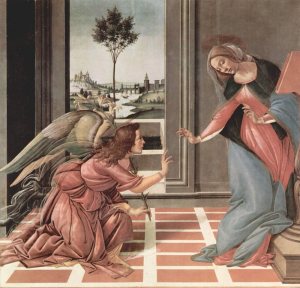
 “Hail, Mary,” says the busy-these-days Gabriel, “you lucky girl, you.”
And Mary said unto him: who, me?
It’s tempting to try to claw our way into Mary’s head when we read the account of the Annunciation; it’s perhaps the archetypal story of the nobody-who-discovers-one-day-that-he-is-Very-Special-Indeed. You’re a wizard, Harry; the Force is strong with this one; yep, that’s a Ring of Power you’ve got there, Frodo. What must this Mary, the proverbial small-town girl, be thinking, when she’s told that God has had His eye on her for a while now?
Or we go straight to slathering the language of virtue atop every move she makes: how modest she is not to have expected an angel to come by and declare her God’s favorite! How respectfully she voices her doubts, not like that nasty Zechariah! How beautifully she submits to the will of God!
Neither is, perhaps, such a very wrong impulse. You can’t help but wonder What It Would Feel Like to be in Mary’s shoes. Mary really is nothing if not exemplary.
But Luke is painting with the brush of Scripture, and Mary’s character isn’t really as much in the foreground as we often make it. Archetypal is a bit overstated; this isn’t the first time this sort of thing has happened to someone in the long history of Israel. Gideon, hard at work in his bootleg wheat-threshing operation, was met by the angel of the Lord, who said to him, “The Lord is with you, you great big hero, you.”
And Gideon said unto him: oh, really? (Followed shortly thereafter by who, me?)
The oh, really? was a very human, very relatable response: if the Lord is with us, He doesn’t seem to be acting much like it. If He wants to help out, how about a good old-fashioned miracle?
And the Lord said unto him: I was getting to that.
Eleven or twelve centuries later, Gabriel is telling a small-town teenager that God has decided to rout the armies of the oppressor, and would she care to lead the charge?
Here’s the battle plan: you’re going to be an unwed mother. Well, not-yet-wed. Name your boy The-Lord-is-Salvation; he’ll be, as that weird Scripture says, a god, a son of the Most High; he will be, not to put too fine a point on it, the Lord’s Anointed, the promised king, the answer to the age-old question how long? How does that sound?
And Mary said unto him: but how?
The Spirit of God, the one that makes people speak God’s words, the one that sends warriors into God’s battles, the one that hovered over the primordial waters, will hover over you too, so that the Word and Power of God will grow from a single cell to have a beating heart, a spinal cord, kidneys, toenails, the whole deal, and in nine months be spoken out of your womb into the world.
His name will be Jesus; his name will be Holy. “Son of God” will be, in his case, no mere metaphor.
This is something new, something unprecedented, not like Elizabeth’s conception, miracle though it is. But look: the meaning of that conception, the healthy 25th-week pregnancy of a heretofore infertile, post-menopausal woman – practically an Abrahamic tradition, really – is that “nothing will be impossible with God.” Trust me, saith Gabriel: Isaac was just a dress rehearsal to the show that’s starting now.
And yes, Mary’s response is as exemplary as you could ask for: I am at His service. Yes.
It is a response of faith, yes, a response of submission. But it’s maybe easy to lose sight, when we talk about faith these days in the comfortable West, of the fact that this response of faith is a plea for protection. I am, says Mary, the Lord’s slave girl; over a thousand years before, her ancestor had said, “I am Ruth, your slave; spread your wings over your slave, for you are a redeemer.”
The miracle might well cost Mary father and mother, honor, friendships, and not least her betrothed – if it didn’t cost her life. The answer of faith meant: spread Your wings over Your slave, O God, for you are a Redeemer.
Perhaps it’s not so terrible to mine the story for insights into the character of faith, or for a lesson on how to listen and answer God’s call. But more than anything, especially these days, I’m convinced we need to see this as family history. How is it that (despite the manifest improbability of it all) we have come to be here? to be believers in an Anointed named Jesus? What did it take for this to happen? What sort of a God goes about things this way?
We are here because what our God does, most characteristically, is to offer something better than what is within the realm of possibility, but which is mutually exclusive with a life lived within that realm. You can be a man of substance and influence in Haran or the father of a multitude, heir of Canaan, and a blessing to all nations. You can move back in with Mom and Dad in Moab and probably remarry at some point or give Naomi a son and be great-grandmother to the Lord’s Anointed. You can get married and be a respectable woman in your hometown or be the God-bearer. Never both.
What sort of a God is this? A God Who has something to offer that is mutually exclusive with the realm of human possibility. You can live the life you know how to live or live the life of the age to come. The offer stands until the end of the age.
May it be to you according to His word.
 The Grabers to Germany
Pingback: He Has Shown Strength With His Arm | The Berlin Grabers