
So the first thing Mary does is, she heads off to visit Auntie (maybe even Great-Aunt, or Cousin or something) Elizabeth, who has thus far been keeping her big news under wraps. It makes sense: who else do you talk to about a thing like this? What better way to make sure the whole Gabriel thing wasn’t a crazy hallucination than to have a tête-à-tête with somebody right in the middle of her own miracle?
And on her arrival, lo! John the Fetus did give a mighty leap of exultation before Mary and the Holy Clump of Cells within her.
It is magnificent, this little scene of two mothers, old and young, virgin and barren, prophesying to one another. Their words fly in the face of all reason, weaving a tapestry of Scriptural thanksgiving and praise for their God’s bestowing the honor of a (to all reasonable appearances) illegitimate child on a girl who certainly will face divorce as a consequence of her apparent adultery, and perhaps death.
Yet once again, the echoes down the centuries of Israel’s history paint the encounter in an astonishing light. Gabriel has already met Mary with a hero’s greeting; now Elizabeth does the same: having arisen as a mother in Israel, she hails a new Jael as the most blessed of women, one whose words – “let it be to me according to your word” – are a mallet and tent peg in her hand to drive through the serpent’s skull.
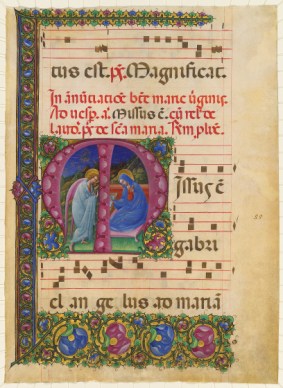 Mary’s song, the Magnificat, is likewise – always catching me more by surprise than it ought to – brash, defiant, exultant, not merely in the “God gives me amazing feelings” sort of contemporary Christian mode of expression but in a way that positions her as a worthy heir to her namesake Miriam (likewise unmarried, as far as one can glean from Exodus and Numbers), the singer-prophetess who led the women of Israel in their triumph over defeated Pharaoh so many generations before.
This child, newly created in the virgin’s womb, already constitutes a stunning victory over the powers of earth.
Such is the whole tone and tenor of this song; in a nod to barren Hannah’s victory chant over her contemptuous rival, she exults in the “scattering” of the proud, the dethroning of the mighty, the hunger of the rich. One hesitates to drag the done-to-death college-essay word juxtaposition into the mix, but it fits: Hannah’s boast in the Lord, who has just brought her from an estate of shame into one of honor, on the lips of one who is, as soon as her situation becomes public, going to be ruined in the eyes of all respectable people.
The coming of Jesus Christ in the flesh overturns – from the very moment of his conception – fundamental things about the way the world works. No longer is the present defined on its own terms; the future, a future in which Mary is known universally as Blessed Among Women, in which Abraham’s Seed is a blessing to all the families of earth, in which David’s Seed sits on his father’s throne forever and ever, has invaded, planted its flag in the soil of the vale of tears.
Why? Because the future is this: Behold, the dwelling place of God is with man. He will dwell with them, and they will be his people, and God himself will be with them as their God. This is what will surely be, what all the energy of God is at work to bring about in the Day of Christ Jesus. This is what it is to be a Christian: to live under the flag of that future, to know that God will dwell with us because He already does, to know that we will be His people because one of us already sits at His right hand.
Because of these things, we can laugh all the darkness, pain, and hostility of the present age to scorn. Our attitude ought to be not unlike the proverbial nervous public speaker visualizing his audience in their unmentionables: we are to look at those with every earthly reason for pride as those who are already sacrificing their dignity at the altar of escape from a lost battle; to look at those enthroned on public opinion or seats of influence as already fallen into obscurity; to look at those who seem immune to justice as already knocked down several pegs.
We are not to fear these people or the powers that puff them up. We are not to fear obscurity; we are known where it counts. We are not to fear want; we have a seat at the King’s table.
 The Grabers to Germany