
We are a few days out from the latest horror of 2016, a deadly attack on apparently random bystanders by means of a hijacked transport truck. This one hit my city, targeting a Christmas market I’ve strolled through in the past, in one of the busier tourist and pedestrian areas of central Berlin. It’s right by the zoo, where we have an annual family pass and take the boys often. It’s a fairly important transit hub, where it’s not uncommon for us to change trains or buses on the way to somewhere across town.
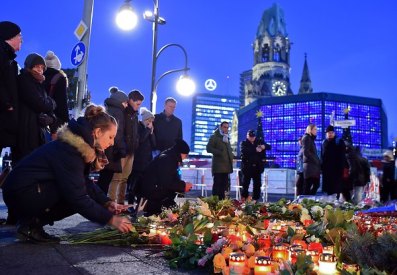 The initial suspect, now cleared, is Afghan or Pakistani (it’s never been quite clear exactly which), a man who came to Germany seeking asylum. We have had a decent amount of contact with refugees from both countries, hearing their stories, sharing meals and glasses of tea. The current suspect, still at large and being sought, is said to be Tunisian. We have Tunisian acquaintances here as well, though they’re people who have been in Berlin a long time. These descriptions are not abstractions for us, imaginary bugbears from far away. Both victims and perpetrators could be (though they’re not, as far as we know) our neighbors, acquaintances, friends.
It seems wrong, just at the moment, not to have Something To Say. The politicians all do. Social media are alight with calls to prayer and expressions of sympathy, calls for tighter immigration controls and calls for compassion for refugees, all the usual back-and-forth.
I have no policy proposals. Opinions on immigration policy and Islam, sure, some of them probably better informed than others. My take, though, more than anything, is a very basic, not at all original to me observation about what we – we human beings, I mean, or at any rate certainly contemporary Westerners – are like, and what we assume mistakenly to be the case about the world.
The problem is what we all implicitly acknowledge the question to be: how can we be safe? How can we make it so this doesn’t happen? Do we need to be nicer to or tougher on Muslims? Do we need more video surveillance or less? Do our borders need to be more closed or more open? Do our gun laws need to be more or less restrictive? How can we get Them to stop hating our freedom?
Perhaps, if we were to get the answers right on every single one of these things, we would be perceptibly more safe. Perhaps. For a time. But at some point, we would find some new questions, questions which would seem equally, terrifyingly urgent to answer rightly, as once again we ran headfirst into the brick wall of the reality that no one is safe and we are all going to die.
It’s a perennial observation, a truism, something so obvious as not to need stating: we are all going to die, and our safety is really an illusion. The world is out of our control; even the forces and phenomena we understand relatively well are too complex for us ever to truly master. Someday, sooner or later, cancer or terrorism or heart disease or drunk driving or a falling piano or just sheer time or something is going to be more powerful than we are, and we will succumb to death.
And yet we spend untold emotional, physical, and mental energy trying either to combat this inevitability or to ignore it. I dare say just about everything we do for pleasure or comfort, for self- or civic improvement, has one of these as its ultimate goal: to stave off death, or to numb ourselves to its sting.
Hence the real outrage at evil deeds like the Breitscheidplatz attack, the inevitable this could have been prevented if only… declarations that well up in our throats and pour forth from every pundit. Death has intruded into our fun, asserted itself in a public and powerful and horrific way, and given the lie to all our distractions and efforts at achieving control over our fate. Any number of things could have prevented this – but they didn’t.
In the end, then, we are shaking our fists at an unsafe God who has made an unsafe world. Like so many evangelicals of the last half-century (and may the Lord make them a thousand times as many as they are), I’m a bit of a C.S. Lewis disciple. One of his many indelible sayings comes from the description of Christ figure Aslan in The Lion, the Witch, and the Wardrobe: “Safe? … ‘Course he isn’t safe. But he’s good. He’s the King, I tell you.”
We like this. It sounds romantic and exciting. But Lewis provides some exposition of the saying in The Silver Chair, in Aslan’s own self-description: “I have swallowed up girls and boys, women and men, kings and emperors, cities and realms.” Our God is unsafe, in the deepest and most meaningful sense of the word: it is up to Him when and how we will all die. And He may have us die at a time and in a way for which we are not ready.
And we cannot, of ourselves, ever be ready. In our world, the devil – our cosmic Accuser – has the power of death, because death has the sting of sin, and sin the power of God’s holy and righteous law. We cannot be ready for death, because death dooms those who stand condemned. That’s why it strikes such a tender nerve when death intrudes on our “normalcy.” Our normalcy is nothing normative for God, nothing He has promised, nothing He may not at any time lay aside, to our destruction.
How then shall we live and grieve and have our celebration this unsafe Christmas? It is easy enough to appeal to vaguely hopeful bromides about love conquering hate, light shining in the darkness, that sort of thing. Berlin is full of them right now. But too often, I think, these sentiments are just as light, insubstantial, ephemeral as the “joy” of the season that dissipates in the face of tragedy (and Breitscheidplatz is only one facet of the darkness all around). What we need is heavy joy, substantial hope, solemn and solid festivity.
I love the trappings of Christmas: pretty shiny things on the tree, unreasonable amounts of sugar all around, tchotchkes and sentimental songs and all that good stuff. It is good stuff, and stuff is good. But let us, us Christians at least, not use these in the way we’re inclined to by nature – to paper over the cracks in our world with the notion that people really aren’t so bad deep down, or to drown our sorrows in tinsel and eggnog and nostalgia. The way to resist the power of evil in our world is not found in resenting it for crashing our party.
To deliver those enslaved through the fear of death, the Scripture says, our Christ partook of flesh and blood. He signed up for this, for life in a world where tyrants slay the little childer, life in which every millisecond of continued existence succeeds only at the pleasure of the Father in heaven. He came, in fact, to succumb to the danger – in order to rob the devil of the power to secure his people’s damnation. He came as the token of God’s good will, the promise that God is not only vaguely well-disposed toward His benighted creatures, but that He will not be kept from them, not by death or violence or any other damned thing, and that in the end “it was all worth it” will be the understatement of all eternity. The only real resistance we can put up to this world’s evil is to think, speak, and act as if all of this is true.
We are not safe. He is not safe. But He’s good. He’s the King, I tell you.
-Ben
 The Grabers to Germany