
Now the time came for Elizabeth to give birth, and she bore a son…
The last notes of Luke’s prelude to Christ ring out in the Benedictus, deaf and dumb Zechariah’s song of praise; this is the first of the great signs of the times, the things Jesus will point to when this same baby boy sends his disciples to ask whether he is indeed the One to Come.
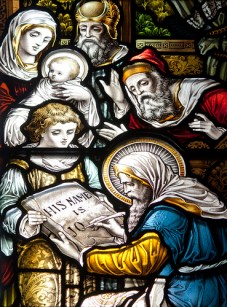 What is announced by the birth of John, Luke wants us to see, is the Day of the Lord’s Vengeance. It’s no coincidence that the tongue of the mute sings for joy at the birth of the one who is to prepare his way in the wilderness. We’re to see the Day dawning here, blazing forth in the healing ministry of the Anointed, continuing in the at once blinding and eye-opening self-disclosure of the Resurrected to another blameless Jew.
The hand of the Lord was with him, it says, to save his people from the hand of those who hate them, the hand of their enemies. Hands in the Bible are, by and large, not for caressing, not for acts of gentleness. Hands wield, are raised against adversaries, are trained for war. This child is a weapon in the hands of the Almighty, an instrument of judgment, vengeance, overthrow. Luke’s first chapter is overwhelmingly martial in tone – God is coming to Israel, the King of Glory, mighty in battle. It is a great and terrible Day that is dawning; the Sun of Righteousness rising on the elect will set the wicked ablaze.
What will this child be? He will be the prophet who comes in order that his people might not all be burned to stubble by that dawn. No wonder all the neighbors were gripped by fear; they must have had some inkling of the answer to their whispered question.
Do we realize that this is what Christmas is – the beginning of the decisive offensive in the real War To End All Wars? Do we grasp that there is a war on, one with only two sides, one with only one possible outcome, of which every one of us on either side of it must become a casualty?
The band Wilco put it this way: You have to lose / You have to learn how to die / If you wanna, wanna be alive. I don’t claim to know what Jeff Tweedy thought he was getting at with those words, but it’s an incomparably efficient expression of what this gospel in Zechariah’s song demands. Deliverance, serving God without fear, knowledge of salvation in the forgiveness of sins, light to those seated in death’s shadow, guidance into the way of peace: John will die a sad and ugly death for proclaiming these things. His relative Jesus will die a worse one in order to realize them.
Light and life lie on the far side of darkness and death. God’s people would be saved from the hand of their enemies because Jesus would fall into that hand. He would pass through the darkness and out the other side so that we might learn how to die without being lost forever.
The life we know how to live, the one we are born into and are trained up in, is living death. It is enlistment in the army of a power hostile to the proper Sovereign of the world it seeks to dominate. You have to lose if you want to live. You have to die if you want to conquer. This would be John’s message: act as if God is coming to kill you, and when He does, He will raise you up on the last day.
Jesus Christ, the baby in the manger, the man of sorrows, will show us how. Get ready for
Christmas: believe that, in the truest sense, the End Is Near. Learn from this Jesus how to die. Learn from Zechariah, from Mary and Elizabeth and Gabriel, just what will dawn on you when you do.
And now: by the tender mercy of our God, may the sunrise visit us from on high
to give light to those who sit in darkness and in the shadow of death,
to guide our feet into the way of peace.
Amen and amen.
 The Grabers to Germany