
“The first man Adam became a living soul”; the last Adam became a life-giving spirit. (1 Cor 15:45)
My job more or less boils down to figuring out how to make the Christian message, the gospel, make sense to someone who hasn’t grown up hearing it and who may well be hearing it from me in his or her (and my) second language.
That’s a good spiritual discipline. You need to think hard about what you need to know in order for Christmas and Good Friday and Easter to make any kind of sense to the hearer. You need to think hard about what you know that makes these stories make sense to you, or whether they do make sense to you, you who would claim that believing the stories are true is just about the most important thing anyone can do in their life.
I really would claim that. In a box of hand-me-down books my four-year-old son was given recently is a copy of The Story of Jesus (a Little Golden Book by Jane Werner Watson). It’s nice enough for 22 of its 23 pages, with plenty to quibble about but nothing grotesquely wrong – and then, after a survey of Jesus’ teaching, comes this gem of a final page:
After Jesus’ death, his followers took his teachings all around the world. And the stories he told are still known and loved and retold today, in every land on Earth.
 Granted that Little Golden Books probably wouldn’t go for a two-page spread of a blood-drenched crucifixion scene, the way Watson manages to gut the message and meaning of Jesus is nauseating. How did Jesus die anyway? To all appearances, he passed awa
y peacefully, surrounded by friends and family, having written a couple of bestsellers on How to Be Nice and Not Worry So Much, which his followers thought were just so swell that they just had to hand out copies to all their friends.
Easter only makes sense if we realize that our problem isn’t really that we don’t know how to live. Jesus didn’t come to tell us how to live. We know how to live.
Our problem is that we don’t live that way.
And so the Bible keeps saying, all the way through, that something fundamental about who we are needs to change. God makes promises to make us into people who will live as we know how: The Lord your God will circumcise your heart. I will give you a new heart, and a new spirit I will put within you. And I will remove the heart of stone from your flesh and give you a heart of flesh. I will put my law within them, and I will write it on their hearts. You must be born again.
Jesus died for our sins. That is gospel. But if Jesus dies for our sins and stays dead, then we are still who we are, still with our old hearts, still the sort of people who will sully a clean slate the second it’s handed to us.
The first man Adam became a living soul, it says; he was of the earth, a dust-man. There was nothing wrong with that. He was enlivened by the breath of life breathed from God into his nostrils, enlivened by the greatest intimacy God had engaged in with any creature of His. It was a beautiful way of being. But then he disobeyed God, and it was spoiled, and instead of being planted and blossoming into the glory for which he was destined, he died and stayed dead.
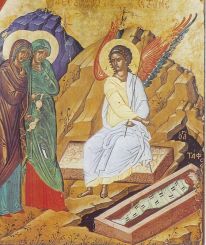
If Jesus died and stayed dead, then this is still how it works, and the old way of being, which started out beautiful but was spoiled, is still the only way of being. But he didn’t. He was raised in glory, becoming a life-giving spirit, a man of heaven. He is not a frail thing of dust drawing breath from God; he is an immortal victor whose human life is so fully united to that of the living God that the almost unbearable intimacy of the moment Adam was awakened into life seems almost cold and distant by comparison.
And that union means that, being alive, Jesus Christ can give life. He can give the kind of life that permeates his entire being, that sustains him, that means that he will never again be subject to death. It means he is there to give to all who ask, to be found by all who seek, to open to all who knock.
It means that what God intends to do with people in order to save them from death and judgment has happened to someone, and that He so identifies us with that Someone that we simply are no longer the dust-people we once were, broken and dying, and that He breathes the life Jesus now experiences into us so that we – slowly, incompletely, even haltingly, but inexorably – blossom into the image of the heavenly Man.
He is risen indeed. Alleluia!
 The Grabers to Germany