
Oh, Samson.
If ever there were a time to blame the victim—at least in part—this is probably it. The man’s predilection for a certain kind of woman has caught up with him hard. The Worst Nazirite Ever is reaping the harvest of lifelong carelessness about his calling. He made his bed; now he’ll lie in it.
And yet… and yet he has actually struck a series of blows against his people’s oppressors, sowing some much-needed disruption in the fallow field of an Israel far too content to be slaves in their own land. He has done the Lord’s work, and he has paid the price of being savior to a people unwilling to be saved. Delilah handed him over for a princely sum of silver; the men of Judah had been willing to do it for free.
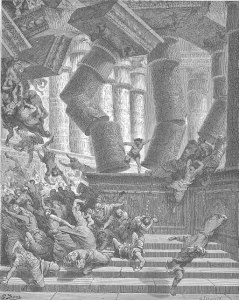 Now Samson embodies his nation fully. Darkness has fallen on a man named Sun (in Hebrew, he’s Shimshon, from shemesh, “sun”), called to be a light. He’s been enslaved, the penalty for his own faithlessness. He’s become a spectacle to the nations. He is Godforsaken, desecrated, weak. His enemies’ attitude is summed up in one detail: they don’t bother with haircuts for their prisoner. Surely, they think, having broken the Nazirite code so definitively, he has forfeited all help from his god.
Yet they have failed, fatally, to reckon either with Yahweh’s power or with His mercy.
They have taken what is the Lord’s: the hair of the Nazirite’s sacred head, God’s due, to be laid upon the fire of the peace offering at the completion of his vow (Num 6:18). Samson is at fault too, but in the end it was Delilah’s crony, in the Philistine lords’ pay, who took what was holy to Yahweh, incurring His jealous wrath. Then, too, they have not reckoned with this God’s single-minded devotion to His purpose to make this people of His the instrument of His judgment and mercy.
And so Samson calls upon the name of the Lord, asking to be remembered and strengthened, to avenge himself upon his enemies. His prayer granted, he brings the judgment of God down upon himself and them together, in his death achieving a greater victory than any he had gained in life.
Behold the man: the greatest and worst of the Judges, his enemies reveling in victory and finding themselves deceived in the end.
Behold the man: the Judge of all the earth, his enemies reveling in victory and finding themselves deceived in the end.
Christ hangs there, having done the Lord’s work and nothing else, paying the price of coming to save a people who do not want his salvation. He has been betrayed for a slave’s price in silver, handed over to the Romans for nothing. He is a spectacle, a brutally effective one, the Gentiles reveling as they humiliate Judah’s king, the Jews satisfied that this pretender, this blasphemer, has forfeited all claim on God’s help.
Yet they, the cronies of the powers of sin and death, have taken what belongs to the Lord, a most sacred head—recall that Jesus swore off the “fruit of the vine” on the eve of his betrayal (Luke 22:18)—incurring God’s jealous wrath. The Christ calls upon the name of the Lord, and with the last of his strength pulls down the judgment of God upon himself and his enemies.
So he dies, and the Light of the world, the Sun of Righteousness, is darkened.
But in this moment, the foes of the living God and of His people find their temple crashing in upon their own heads, because not only have they committed this sacrilege, this theft of what is holy to the Lord, but they have called Good evil—they have slandered the Holy One of Israel, rejoicing in the destruction of one truly righteous and imagining this one to be rejected by God whom God must deliver from the grave.
This is no defeat.
 The Grabers to Germany