
The Lord said to Moses, “Consecrate to me all the firstborn. Whatever is the first to open the womb among the people of Israel, both of man and of beast, is mine.” …
“When the Lord brings you into the land of the Canaanites, as he swore to you and your fathers, and shall give it to you, you shall set apart to the Lord all that first opens the womb. All the firstborn of your animals that are males shall be the Lord‘s. Every firstborn of a donkey you shall redeem with a lamb, or if you will not redeem it you shall break its neck. Every firstborn of man among your sons you shall redeem. And when in time to come your son asks you, ‘What does this mean?’ you shall say to him, ‘By a strong hand the Lord brought us out of Egypt, from the house of slavery. For when Pharaoh stubbornly refused to let us go, the Lord killed all the firstborn in the land of Egypt, both the firstborn of man and the firstborn of animals. Therefore I sacrifice to the Lord all the males that first open the womb, but all the firstborn of my sons I redeem.’ It shall be as a mark on your hand or frontlets between your eyes, for by a strong hand the Lord brought us out of Egypt.” – Exodus 13:1-2, 11-16
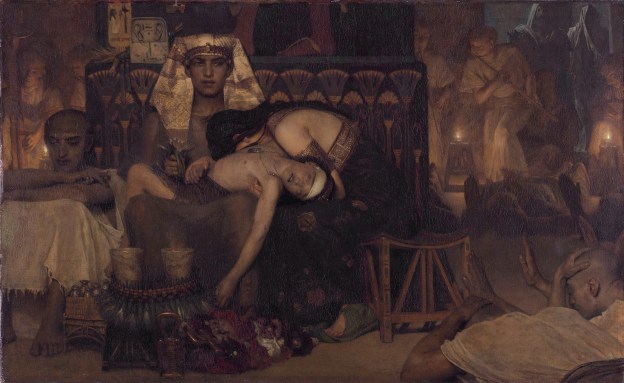
At the climax of ten plagues, God struck the Egyptians a blow that loosened their grasp on their Hebrew slaves just long enough for them to flee by night and set out for Sinai. There was a poetic justice in it: the infanticidal oppressors paid for their king’s obstinacy with their firstborn, man and beast.
God made a crucial distinction that night: Israel’s firstborn, and theirs only, would be spared. It seems logical to those of us who grew up with Sunday School stories, intuitive as story-logic—since after all the Egyptians were the Bad Guys who had it coming. But Scripture prompts an uncomfortable question: what is the actual difference between the Israelites and Egyptians, when we get right down to it?
Yes, the oppression went in one direction. And yet we aren’t given the slightest hint that the Israelites are basically more pious or righteous than their oppressors; just look at the story of Moses’ first misadventure as a would-be liberator. The Hebrews are members of their masters’ household, and they have taken on a sort of family resemblance. They are devotees of their gods and participants (to whatever degree of willingness) in their corrupt social order. So where does God get off showing this sort of favoritism?
Amazingly, God’s own answer is not of the I am the potter and you are the clay sort, asserting His divine prerogative and telling the creatures to deal with it. Rather, He says, Israel is Mine. Israel is God’s firstborn son, His very own.
The claim is rooted in history, in God’s promises to Israel’s ancestors; the Lord is keeping His word to Abraham, Isaac, and Jacob. But there’s a tension here between the place of God’s people in His plan and the reality on the ground, as there will be throughout Scripture: how can God treat these people differently, when they simply aren’t different?
This is where the Paschal lamb comes in, a provisional solution, a way for God to acknowledge the fact that He is differentiating between people who are not different in themselves and still carry out His purposes for those whose God He has promised to be. And from then on, in an ongoing way, Israel will acknowledge this tension as well, by setting aside all the firstborn as God’s exclusive property and leasing back those who may not be offered on His altar (unclean animals and sinful humans). God says of Israel, they are Mine; and to remind them of the judgment from which He has spared them, He says of their firstborn too, they are Mine.
It is no accident that Christ died at Passover, and it is no coincidence that Christ is in so many places called “firstborn” (Rom 8:29; Col 1:15; Heb 1:6), and especially “firstborn from the dead” (Col 1:18; Rev 1:5). In the fullness of time, God claims what is His.
How will God make a distinction between His redeemed people and the house of slavery His world has become? The stroke of judgment will fall on the firstborn of all creation itself (Col 1:15). He is the Firstborn, of Judah, of Israel, of the ends of the earth, and God has called in their debt and accepted him in payment, not provisionally but definitively.
Yet this firstborn is different in himself from the creation in its alienation from and rebellion against its Maker. And so God raises him up, this sinless one become sin, this immortal one engulfed by the grave, and in so doing deprives death itself of its firstborn (Col 1:18), striking the blow that looses the grip of sin and death on the people of God. Jesus Christ the firstborn opened the womb of Mary, then the womb of the earth itself, and thus God says of him, he is Mine.
How, then, do we find it said of us: they are Mine? This is what faith does; it’s not just a vague notion that things will work out for the best, not even just the unverifiable assertion that it really did happen this way, but the offering up of this one to God as our firstborn, one we do not lose when God receives him. His death and his resurrection sever us from the household of slavery into which we were born and in which we were raised.
And so God has laid claim to His Firstborn, to our Firstborn, and through him, on us—so that all things are yours, and you are Christ’s, and Christ is God’s. Because he is risen, though our lives are forfeit to God, they are also indestructible, imperishable, waiting to be revealed and lived to ages of ages.
He is risen indeed!
 The Grabers to Germany