Tag Archives: missions

Strategy and the Spirit

I like the short piece Ray Ortlund posted this morning on his Gospel Coalition blog, a judicious and compact statement of where church multiplication – what in our circles falls under the heading of “church planting movements” – comes from.
ImageStrategic plans are good and helpful, he says, but they are not what brought about the exponential growth of the early Church described in Acts 9:31; that comes only by the miraculous work of God to transform people’s character. It’s a good word for American evangelicals whose churches have tended to be enamored of programs, strategies, vision statements, branding and the like, often under the influence of the thought world of corporate business. Without any such deliberation, a little Jewish sect became a world-transforming people, because they were characterized by the “fear of the Lord and the comfort of the Holy Spirit.”

I like this because it pushes against some really harmful ideas about what sort of an outfit the Church is supposed to be, but despite Ortlund’s avowal that he doesn’t at all object to strategy in church planting and leadership, I can’t help feeling a little defensive. Our missionary call right now, after all, is to go and serve a church plant that was started by a group of people trusting God to provide growth – by helping (among other things) to develop and implement the vision and strategy they have lacked, and in the absence of which they have not multiplied.

Strategic planning is easy to defend pragmatically, or even theologically “as a matter of wise stewardship” (Ortlund’s approach). But I think both of these defenses of the kind of work we will be engaged in tend to promote the idea that strategy is our part of the equation, while the Spirit is God’s. There’s a sense of sacred/secular divide here: by our strategic efforts we stitch together a Frankenstein’s monster that God must then enliven with a bolt of lightning; or God kindles a fire that needs our carefully constructed log pyramid to reach its full bonfire potential, something like that. Part of the work is God’s business, and part of it is ours, and we get things right by not getting the wrong idea about how big our part ought to be. (Ortlund does not mean it this way, of course.)

But the Lord’s work in the world isn’t like that. It is really dangerous to imagine that we can strategize on a purely pragmatic basis and offer this up as a component of God’s work to grow His Church, just as it would be fatal to imagine that Jesus was 35% man and 65% God (or any other proportion of each). It matters what kind of strategy we’re trying to develop and implement, and our categories, even if they look like or are inspired by what we’ve learned from the business world, need to be drawn from God’s revelation to us.

The sermon at our home church on Sunday hit home with me as I think through this. The pastor, preaching from Colossians 4:2-6, taught that the Church’s mission comes down to three tasks: faithful prayer, wise conduct, and gracious speech. If our vision and strategy aren’t really efforts to promote these three things by proclaiming the grace that trains us in godliness (Titus 2:11), then they are really impediments to the work of the Spirit – just as a “Spirit-led” approach that refuses to be trained in these things can itself constitute a strategy that hinders that work.

So we will think and talk about a “target group” for our church plant, but if we don’t mean by this a simple awareness of who our neighbors actually are in the place God has put us, we’ll be of no good to that group or any other. We will think and talk about a “philosophy of ministry,” maybe even a “mission statement” (much as I abhor that particular jargon), but if we don’t mean by that a commitment to praying for our neighbors and giving them the proverbial cup of cold water in the Lord’s name, our philosophy will be at cross purposes to God’s. We may put together an evangelistic strategy, but if the heart of that strategy isn’t building up the church in faith, hope, and love by word and sacrament, it will be doomed sooner or later.

The medium is the message. The strategy has to be the fear of the Lord and the comfort of the Holy Spirit, or else it is no stewardship at all.

-Ben

When Do You Leave?

It’s the first question we get from just about anyone who knows (a) our names and (b) that we’re missionaries: “When do you leave for Germany?”

ImageIt’s also probably the hardest to answer, even though the answer is simple: we leave when we are fully funded, when churches and individuals have committed to give enough support to cover our entire monthly budget for at least one term (five years, in our case). It’s an answer Anna and I have given so many times that we feel we must surely be turning blue in the face by now.
But it’s not an answer that seems to resonate. Maybe we as a culture are fond of clear deadlines. Maybe most of us (with what I can’t help thinking of as “real jobs,” in unfavorable comparison with my own) think of work, even ministry work, as basically a contract in which the employee is given a clear start date when he or she is hired – that is, you start when you’re needed, at the pleasure of the one hiring you. For missionaries with some agencies, no doubt that’s closer to the case, and they can leave for the field less than fully supported if the ministry demands it. But there are good reasons for doing it the way our agency does.

The most basic of those reasons is a very obvious reality: our support base is in one country, our work in another, faraway one. Raising support is a task that requires making personal connections – you can communicate well enough from the field, especially nowadays, but it’s essentially impossible to meet new potential supporters and nearly as difficult to turn potential supporters into actual supporters by phone or email. And a second reason is like it: missionaries who have to raise their own support never really get to stop raising support. People lose jobs, encounter unexpected expenses, or just lose interest or forget; church budgets crash because of splits or economic downturns. Support goes away more quickly and often than it accumulates.

Take these realities together, and you can see why it would be a pretty bad idea to send us to the field without even once reaching 100% of our funding. We’d likely never hit 100% ever again, and while we would be able to set a clearer start date and get into ministry earlier, we’d be setting ourselves up to have to leave the field unexpectedly, arguably a much worse outcome than a delayed start.

Still, it’s irksome to have to answer that dreaded FAQ honestly, and that shows more about our hearts than about the realities of mission work. I want to give people a deadline so they’ll know the time to give is now; I want to give a deadline so they’ll believe it’s important for me to be on the field sooner rather than later – so they’ll know I’m important to the team we’re joining. I want to give people a deadline because I’m tired of raising support, and I want to will an end into sight; I want to give a deadline because I want to have the answers.

Mostly, I want to give people a deadline because the real answer is “When God wants us to go,” and that’s an answer that requires me to kill my desire to be seen as important, to be seen as successful, to be seen as having it together. And of course that’s what I need more than anything, which is perhaps the wisdom lurking behind requiring full funding before we can go to the field.

So: when do we leave? When God wants us to go.

-Ben

Hands and Prayer

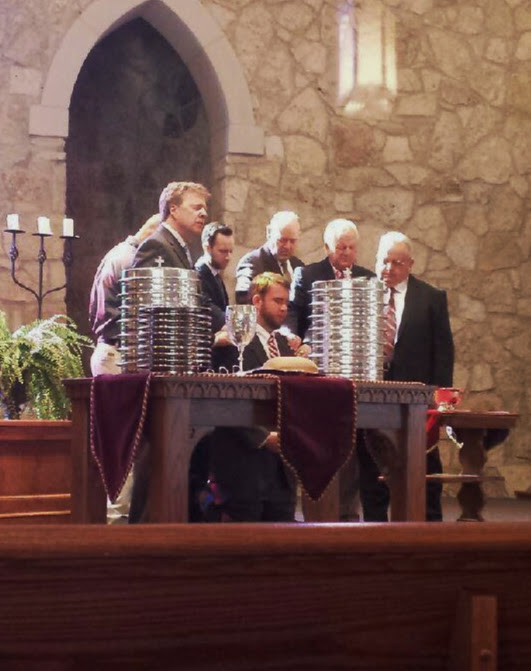
201403309510333895595bestshotThis past Sunday, I was ordained to the Christian ministry. Officially, I’m a Teaching Elder (being called an “elder” has a way of making 30 feel younger than it has since my birthday) commissioned as an evangelistic missionary to Berlin. It’s a strange feeling, a lot like being newly married – hard to process, different and yet not different, at once the culmination of a long, hard-fought, seemingly impossible process and only the beginning of something I feel I can’t possibly be really prepared for.

The ordination took place in the morning worship service at our sending church, and I’m glad for that – a few people remarked that it was the first time they’d seen an ordination take place. There’s a high point to the whole service: once I’d taken my vows, and before I was given a charge, I knelt and was surrounded by the commission of elders appointed to carry out the ordination, who laid hands on me and prayed for me.

That’s the essence of Christian ordination, if we take our cues from the handful of New Testament texts that refer to it (Acts 6:6; 13:2-3; 1 Tim 4:14; 2 Tim 1:6): laying on of hands with prayer. In the Old Testament, it was sacrifices that received laying on of hands (Exod 29:10 and many other places), transferring the guilt of the worshiper to the animal; now, it’s the gift received previously by the elders that is passed on to the ordinand.

In Acts, it’s made clear that this always happens in conjunction with prayer, and that’s the thing that is so good for the congregation to see happening. The founding event in a man’s ministry is an act of prayer, asking God to provide all that’s needed for whatever He asks of the new pastor. Missionaries often make what must seem like an emptily pious habit of asking for prayer in their presentations and meetings. We talk a big game about how much we need individuals and congregations to be in prayer for us, but I imagine most of our hearers are getting squirmy by that point because they know the next thing we’ll ask for is money, the thing we all know missionaries are really after.

That’s part of the process, part of the discomfort of our calling. We do need money, as I’ve detailed recently, and there’s no point pretending we’re not hoping for donors as well as prayer supporters. But ordination happens by prayer, and so does the work of every ordained officer of the church, and so does the mission of God in the world. That becomes a much more pressing reality for us once the money is there and we reach the field; we realize how incompetent and needy we are, and we start to see a correlation between the activity of our prayer teams and the fruit we see. Ask a missionary who has spent time on the field – at least with a healthy team – what he or she misses most about being there, and a likely answer is the experience of intense, regular prayer with others who see praying as foundational to their task.

If an ordination commission has not prayed for an ordinand, they simply have not ordained him. If a church does not pray for its missionaries, it has not sent them. If missionaries are not praying, they are not carrying out the mission; neither are we doing what we were sent to do if we are not asking you to pray for us and telling you how you can intelligently and strategically do so. This is the calling we all share, whether we go or send: to pray for laborers to the harvest.

-Ben

Where Does the Money Come From?

As you can tell from our nifty Berlin-TV-Tower-shaped support thermometer over there on the sidebar, we’ve raised about 70% of the recurring support we need to move to Berlin. We tend to field a lot of questions and also pick up on various perceptions (and misperceptions) about where our support comes from (or is supposed to come from), so I thought I’d try to break down the numbers a little bit and show what our support base really looks like. (Disclaimer: I have no idea how typical we are among missionaries in general. I have a feeling we’re not unusual among those from our agency, but these numbers are our own.)

Here’s what the numbers show:

  1. Most of our support comes from individual donors, not church budgets. We receive support from four churches; only two of those are in our denomination. Together, they account for 32% of our total monthly support need, less than half of what we’ve raised so far. While we are making an effort to seek support from as many churches as possible, it seems reasonable to project that a solid majority of our regular giving will come from individuals. As of this writing, we have 59 pledges from individuals – that’s about 15 individual supporters for every supporting church! We know that we are at least somewhat representative in this respect: while our agency reported a 3% overall increase in missionary support from 2012 to 2013, support from churches dropped 8%.
  2. “Small” pledges add up. New supporters are sometimes apologetic about how small their commitments are, but pledges of $50/month or less account for 37% of the individual support we’ve raised so far. Of course it’s easy to get excited about big pledges when they show up, but it’s important to understand that “every little bit helps” isn’t just a platitude. We wouldn’t be nearly as far along as we are without dozens of people giving at these levels. Every person or family who gives what they can is a partner, somebody who is affirming our calling and investing their resources in us, and that means a lot.
  3. We need a big team. This follows directly from the last two points: we are supported mostly by individuals, and while some of those are able to give at high levels, the overall average is a little over $60/month. If that stays consistent, then we’ll still need about 50 more individual supporters (fewer if we are picked up by some churches at higher levels).
  4. Recurring is recurring. We love year-end giving, we really do – but while it can save the day when budget shortfalls loom, it’s not that helpful for getting to the field in the first place. In theory, if our support account fills up with enough one-time giving, that can be prorated over a five-year term to cover our monthly budget, but that means our account would be drained by the time we are back in the States between terms. What’s crucial for us is commitment, whether that means giving every month (or quarter, or half-year) or promising that a certain part of your year-end giving will go to us every year. Of our 59 individual supporters, seven have made annual pledges, which are together worth $350 of our monthly budget.

We spend a lot of our time lately beating the drum of our need for people to commit to ongoing support, and I think that can be intimidating to people. Who knows whether the monthly pledge I make this year will be sustainable five years down the road? People lose jobs, gain dependents, incur unexpected costs – James 4:13-15 comes to mind. What we are asking when we ask for support is an act of faith, a commitment that only divine providence will allow to be kept. We trust that God has called and equipped us to be sent, and we trust (and hope you will trust) that He is likewise calling and equipping you and many others like you to send, regardless of what the numbers look like to our dim, frail eyes.

-Ben